 |
   |
|
|
Advertisement
|
Rebuilding a Runway Overnight: How Amrize and Kiewit Delivered a First at YVR
The rehabilitation of YVR’s North Runway, originally built in the 1990s, was delivered through a partnership between Amrize, Canada’s largest building solutions company, and Kiewit. Over 6 months, more than 154,000 t of high-performance asphalt were installed during tightly controlled overnight work windows, with the runway reopened to aircraft traffic every morning. “Transforming YVR’s North Runway was a once-in-a-generation project,” said Lincoln Kyne, Regional President, Aggregates and Construction Materials at Amrize. “The performance requirements were exceptionally high, and there was no tolerance for disruption to airport operations.” Material performance was critical. The asphalt mix was engineered and produced locally at Amrize’s Mitchell Island plant and designed to withstand British Columbia’s temperature variability and the heavy loading demands of modern commercial aircraft. The mix was also EPD-certified, reflecting growing attention to environmental transparency in major infrastructure projects. Advanced technologies supported consistency under pressure. mmGPS paver control enabled placement accuracy to the millimetre, while thermal imaging systems monitored temperature uniformity across the asphalt mat – key factors in long-term pavement durability. These tools allowed crews to maintain quality despite the scale of the work and the overnight schedule. Execution required an equally coordinated human effort. More than 100 workers and over 100 pieces of equipment mobilized each night, operating in close alignment with airport operations. Collaboration among Amrize, Kiewit, and the Vancouver Airport Authority was essential to maintaining safety, sequencing, and quality standards while ensuring the runway was fully operational by morning. While the project was specific to YVR, its implications extend well beyond Vancouver. Across Canada, airports are facing aging infrastructure, rising passenger volumes, and increasing pressure to complete rehabilitation work with minimal operational disruption. The North Runway project offers a clear example of how materials innovation, local production capacity, and disciplined execution can enable complex upgrades within narrow construction windows.
As Canada’s aviation and construction sectors continue to adapt to tighter timelines and higher performance expectations, the YVR North Runway rehabilitation stands as a practical case study – demonstrating that, with the right partners and planning, even a runway can be rebuilt overnight.
|
|
|||
© InfraStructures - Tous droits réservés - All rights reserved |

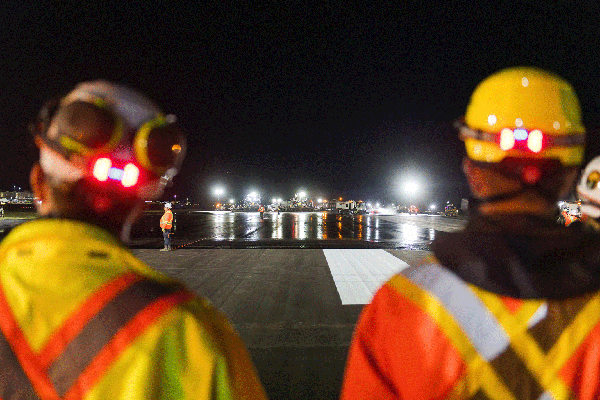
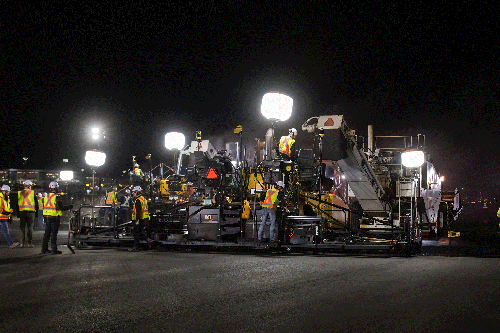 What set the project apart was both its scale and its execution. At the centre of the work was Canada’s first 20-m echelon asphalt milling and paving operation, achieved using two synchronized 10-m screeds. Each night, crews had just eight hours to mill, pave, compact, inspect, and fully clear a 3-km stretch of runway – a compressed timeline that demanded absolute precision in materials, logistics, and coordination.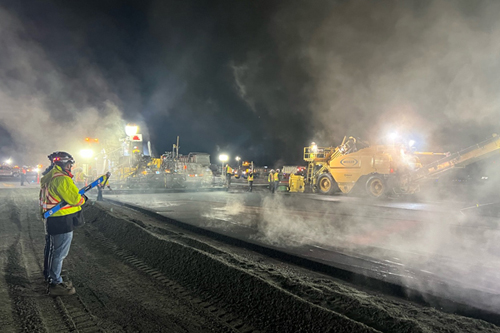
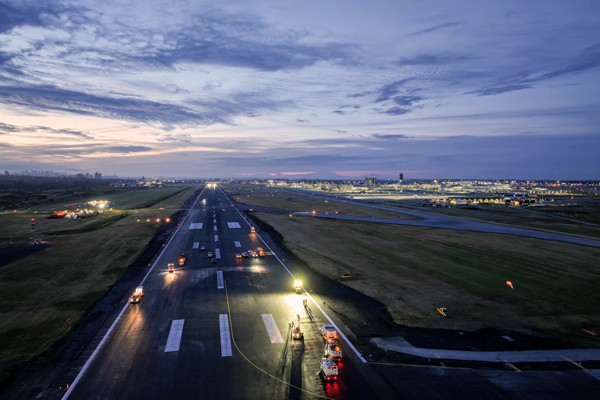 For Amrize, the project reflects the broader role it plays in Canada’s infrastructure landscape. With operations at approximately 450 sites nationwide and more than 7,500 teammates supporting customers in every province, the company brings a scale and distribution capability that is increasingly relevant as infrastructure projects grow more complex and time-sensitive.
 Partagez sur Facebook / Share on Facebook