 |
   |
|
|
Advertisement
|
In Situ Cold Recycling in Bavaria
Germany’s roads are plagued by an enormous backlog of planned or pending rehabilitation projects – especially in the case of communal infrastructure. The main causes of this are high traffic density, adverse weather conditions, and long construction times. Traditional road rehabilitation methods are often pushed to the limit when it comes to cost-efficient project realization. Material and transportation costs are high, construction times are long, and the environmental footprint is frequently less than ideal. With in situ cold recycling, Wirtgen offers a pioneering alternative that is cost-efficient, resource-friendly, and quickly achievable– an ideal solution that also fulfills the road construction requirements of regional, local, and communal authorities. Lead contractor Seizmeir, from Scheyern, used a CR series cold recycler with foamed bitumen technology for the rehabilitation of the ST 2045. Here, hot bitumen is foamed by the addition of precise amounts of air and water and added to the mixing process together with small quantities of a pre-spread cement binder. As a rule, the surface layers, made up of asphalt or granular material, are taken up and mixed with binding agents in a single pass. In the mixing chamber of the W 240 CRi, the foamed bitumen forms fine micro-bonds within the material. These bonds are crucial for ensuring the long-term elasticity of the BSM (Bitumen Stabilized Material) used as a new base layer.
The materials were tested in the construction materials laboratory before the start of the project to find the ideal recipe for the new base layer. In the course of this, it was determined that the existing 50-80 mm asphalt surface layer would be insufficient for the desired end result. In view of this, additional reclaimed asphalt pavement (RAP) from nearby construction sites was mixed in during the cold recycling process to produce the desired 160 mm BSM base layer. The 100 mm layer of RAP augmented the existing asphalt surface layer and, together with the cement binder and foamed bitumen, became a further ingredient of the mix for the new base layer of the road. The result: a homogeneous, bitumen stabilized base layer. In the first phase of the project, a John Deere 672 GP Grader and a Hamm HD+ 140i tandem roller prepared the construction site by grading and compacting the additionally placed RAP. At the start of the cold recycling process, precisely dosed quantities of cement were spread by a Streumaster SW 16 MC binding agent spreader. The existing roadway was pre-milled by W 150 CFi and W 130 Fi compact milling machines from Wirtgen to complete a wider working width. All the milled material was then processed by the addition of foamed bitumen in the Wirtgen cold recycler W 240 CRi. The paving of the BSM layer true to grade and slope by the Vögele paver Super 2100-5i was followed by compaction with the Hamm HD+ 140i tandem roller and final compaction by the HP 280i pneumatic-tire roller. The surface layer was also paved by the Vögele Super 2100-5i, which was fed with asphalt mix by a Vögele MT 3000-2i mobile feeder. The existing base layer consisted of the round gravel typically used in this region – a material that was assessed as unsuitable for inclusion in the cold recycling process. The cold recycler and the milling machines milled down precisely to the upper boundary of the gravel layer. This meant that the road bed remained untouched and the new 160 mm base layer was augmented. The now thicker layer structure thus increased the load-bearing capacity of the road. In the final step, an only 40 mm thick surface layer of new asphalt was paved over the top of the BSM base layer. The entire cold recycling train worked as a rolling construction site along the road, which meant that the sections in front of it and behind it could be used as normal, even by heavy agricultural machinery.
|
|
|||
© InfraStructures - Tous droits réservés - All rights reserved |

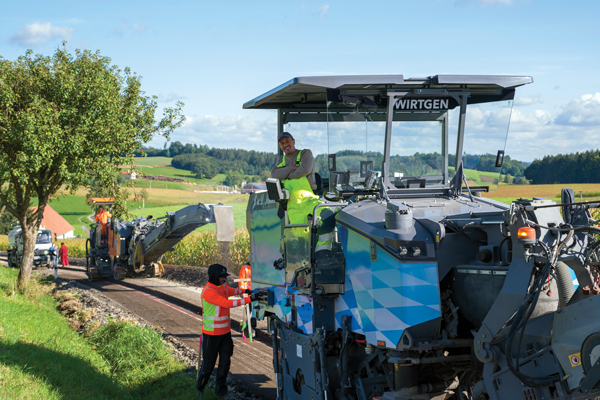
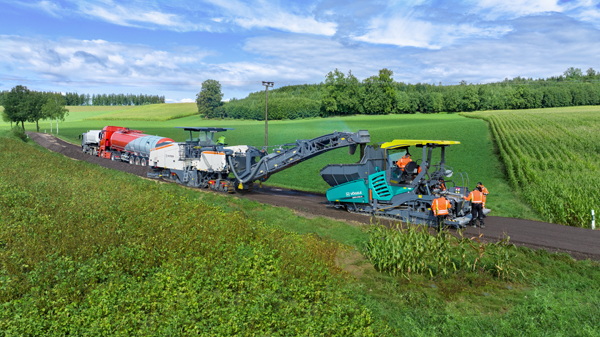 The material was transferred directly from the cold recycler to the material hopper of the Vögele paver and laid down as the train advanced. Here in Markt Indersdorf, the machines achieved an impressive production rate of 360 t/h. No removal of material in trucks, no intermediate stockpiling, and no need for new base layer material were required.
 Partagez sur Facebook / Share on Facebook