 |
   |
|
|
World’s First Land-based Operation of Marine Hydrogen Engine Achieved by Consortium
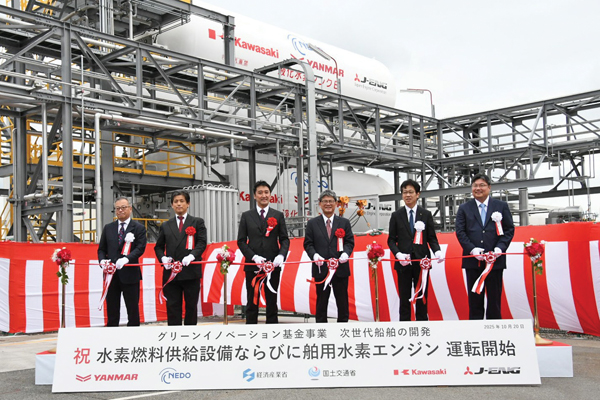
Kawasaki Heavy Industries, Ltd., Yanmar Power Solutions Co., Ltd. and Japan Engine Corporation announced they have successfully conducted the world’s first land-based operation of marine hydrogen engines. The demonstration took place at Japan Engine’s headquarters factory, where a newly installed liquefied hydrogen fuel supply system was utilized. The project is a part of Green Innovation Fund Projects / “Next-Generation Ship Development” of the New Energy and Industrial Technology Development Organization (NEDO), commissioned under the “Development of Marine Hydrogen Engine and MHFS”. In October 2020, the Japanese government declared its goal of achieving carbon neutrality by 2050. To accelerate innovation and structural transformation in the energy and industrial sectors, the Ministry of Economy, Trade and Industry (METI) established a ¥2 trillion ($17.5 billion) Green Innovation Fund Projects, managed by NEDO.
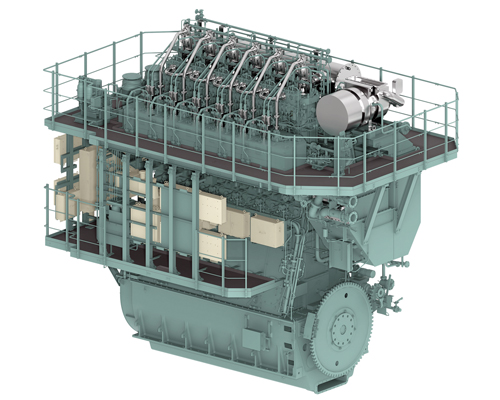
NEDO operates a dedicated website to share updates, activities and related technologies on the fund. Under the “Development of Marine Hydrogen Engine and MHFS”, Kawasaki Heavy Industries manufactured the new liquefied hydrogen fuel supply system, that stores and gasifies liquid hydrogen, supplying it at both high and low pressure to engines developed by the three companies. This enables testing across a range of applications, including low-speed two-stroke main propulsion engines, 4-stroke auxiliary engines and 4-stroke main generator engines for electric propulsion ships. Kawasaki Heavy Industries and Yanmar Power Solutions successfully demonstrated hydrogen combustion in medium-speed four-stroke engines, confirming stable operation at rated output, with the aim of reaching zero emissions. Development will continue to further refine engine performance. Japan Engine is progressing with the development of a 2-speed 2-stroke hydrogen engine, scheduled to begin operation in Spring 2026.
A shared feature of all three engines is the ability to significantly reduce greenhouse gas emissions while maintaining redundancy through a dual-fuel system that can switch between hydrogen and diesel fuel as needed. Next Steps By uniting the technologies of Japanese manufacturers, Kawasaki Heavy Industries, Yanmar Power Solutions and Japan Engine aim to lead the global adoption of hydrogen-fueled ships and contribute to achieving carbon neutrality by 2050.
|
|
|||
© InfraStructures - Tous droits réservés - All rights reserved |
 The fund supports companies taking on ambitious decarbonization initiatives, from R&D and demonstration to social implementation. Priority is given to areas identified in the government’s Green Growth Strategy. Additional budget allocations of ¥300 billion($2.6 billion) in FY2022 and ¥456.4 billion (4 billion) in FY2023 have since been made.
 Partagez sur Facebook / Share on Facebook